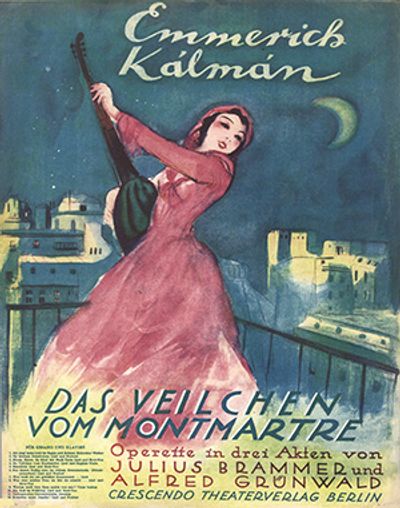
Das Veilchen vom Montmartre
Libretto by Julius Brammer and Alfred Grünwald
Premiere: Johann-Strauss-Theater, Vienna, March 21, 1930
Act I: Three friends—Raoul Delacroix, the painter; Henri Murger, the playwright; and Florimond Hervé, the composer—live together in poverty in a Montmartre garret. Their muse, Ninon, despite her love for Raoul, has just been lured away by the social swirl of Parisian high society. The bailiff Pisquatschec appears, ostensibly to offer the artists one last chance to pay their overdue rent before they are evicted. He informs them, however, that a marquis who is an admirer of theirs had, on his death bed, paid off all their outstanding debts and provided each with 1000 francs. The artists celebrate and start making plans for a study trip to Italy. Their imminent departure greatly saddens Violetta, the so-called Violet of Montmartre, a street singer indentured to a cruel musician/overseer named Parigi. She wants only to help her starving artist friends and hopes that Raoul will someday return the love that she feels for him. When Parigi threatens to kill Violetta, her three friends come to her rescue and buy out her indenture for 3000 francs. The artists welcome Violetta into their home and wish her good dreams as she falls asleep on a makeshift bed.
Act II: Over the months, Violetta has become indispensable to the household, but still dreams that Raoul will take more serious notice of her. Ninon, meanwhile, has become the mistress of the Minister of Fine Arts, but still finds time to tease Raoul, who tries but is unable to resist her charms. When Violetta tries to regain his attention, he dismisses her with claims that he needs a rose, not a violet. Pisquatschec, although sympathetic to the artists’ plight, has no choice but to serve them with an eviction notice. Faced with a homeless life in the courtyard, the artists try to make the best of the situation, offering thanks for what they do have. As soon as the Minister leaves Ninon’s side, she confronts Raoul and confirms her love for him as she pulls him seductively into the bedroom. Violetta, seeing and hearing all this, is tempted to report all to the Minister, but when the Minister does appear, her devotion to Raoul gets the better of her and she instead secures from the Minister a position for Raoul as restorer at the Louvre. Later that evening, at the Narcissus Festival, Raoul is informed of the position and led to believe that it was at the behest of Ninon. Violetta is heartbroken and decides that she would be better off back on the streets with Parigi.
Act III: A few months later at the Vaudeville Theater, Ninon is scheduled to sing the lead in Murger and Hervé’s new operetta, A Kiss in Springtime, but learns from a letter that Raoul no longer loves her. She is furious and walks out, leaving the show without a lead. Violetta, after being gone for several months, reappears to help her friends and offers to play the part, which she had learned while living in the same house as the composer and librettist. Raoul finally realizes that he has been blind to the one girl who adores him and whom he really loves. Just before Violetta makes her entrance on stage, it is revealed by no less than Baron Rothschild that she is actually the daughter of a countess and that she had been kidnapped at birth. She has rediscovered not only her love, but also her mother. Violetta wishes to leave immediately to reunite with her mother, once again leaving her friends without a lead performer. Ninon returns, contrasts her own self-indulgent lifestyle with the true love that she sees in Raoul and Violetta, and says that she will finish the show.