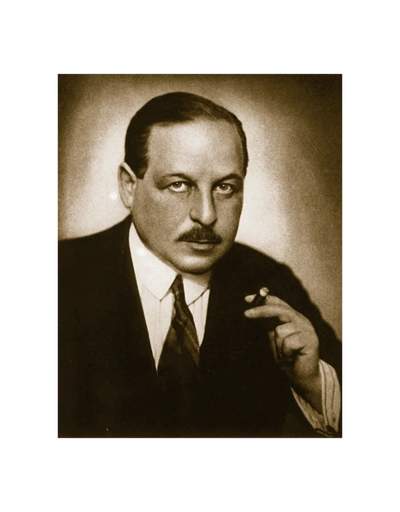
EMMERICH KÁLMÁN: A BRIEF BIOGRAPHY
COULDN'T SING! WOULDN'T DANCE!
During his lifetime, Emmerich Kálmán was the toast of Central Europe. Today, thanks in large part to his immense popularity in Eastern Europe (and especially Russia) and the renewed exploration of his works throughout Europe and in the United States, he is arguably the most performed operetta composer in the world. Since his death in 1953, he has reigned supreme, with Johann Strauss and Franz Lehár, as the preeminent composer of Austro-Hungarian operetta, irresistibly uniting the waltz stylings of Vienna with the csárdás-infused rhythms and harmonies of his homeland. His works continue to hold the stages in all corners of the globe, with audiences discovering and rediscovering his magical gifts for melody, orchestral color, and the fusion of music and drama.
EARLY LIFE. Emmerich Kálmán was born Koppstein Imre on October 24, 1882 in the village of Siófok on Lake Balaton in Hungary. Next to the family home was a small arena that hosted summer stock performances—it was here, at the age of six, that Imre was first exposed to musical theater. Just before his tenth birthday, he was sent to live with his sister in Budapest and attend the Evangelical High School, but with the Magyarized name Kálmán replacing Koppstein. At the age of 13, he learned that his father, once a successful businessman, had declared bankruptcy and lost both his fortune and the family home. As a means to escape the sorrows of this life-changing event, Imre turned increasingly to music. He was shy … he was introverted … but he was ambitious in his musical pursuits, setting his sights on a career as a concert pianist and symphonic composer. A nerve injury to his arm snuffed out any pianistic aspirations and left him with no choice but to compose. He eventually enrolled in the prestigious Budapest Academy of Music, where fellow students included Béla Bártok and Zoltán Kodály. Early compositions included songs, symphonic poems, and solo piano works, although he confessed later in life that "tunes kept getting in the way" of his serious works. As a first step toward negotiating the transition to operetta, he composed cabaret songs and two small-scale musical comedies. Although these early works generally earned critical praise, Kálmán was unable to secure a publisher and, in seeming desperation, feared that he “might have to write an operetta.”
In 1908 his first full-scale operetta, Tatárjárás, premiered in Budapest. The work attracted the enrapt attention of Vienna operetta managers, who brought both the show and composer to Vienna. Kálmán maintained his Hungarian citizenship, but did embrace, for marketing purposes in the West, the translation of Imre into the more international Emmerich. The show, Ein Herbstmanöver, opened at the Theater an der Wien in 1909 and created an immediate sensation. Within six months, it had reached New York and spread to European capitals as distant as Moscow. Kálmán's first work written expressly for the Viennese stage, and an even bigger hit, was the 1912 operetta Der Zigeunerprimás, which starred the aging grand seigneur of Viennese operetta, Alexander Girardi, who delivered the soon-to-be Kálmán signature tune, “Mein alter Stradivari.” This show validated the success of Ein Herbstmanöver and confirmed Kálmán as a major player on the international operetta stage.
GEM AFTER GEM. Although Kálmán's operettic star had been rising steadily since Tatárjárás, there was little to prepare the musical world for what would emerge as the universally most popular of his 20 operettas. Die Csárdásfürstin, featuring Mizzi Günther (the original Merry Widow) as cabaret singer SyIva Varescu, opened in Vienna in late 1915. The work has been translated into more than 30 languages, recorded commercially in more than 60 versions, and is still staged regularly throughout the world. Die Csárdásfürstin belongs to that rarified group of operettas whose every musical number is an acknowledged gem. Famed British humorist P. G. Wodehouse, who reworked the libretto for the show’s 1917 presentation on Broadway, remembers the score as "about the best anybody ever wrote."
Kálmán now entered the most fruitful period of his creative life, spinning out eight operetta gems for Vienna at approximately two-year intervals between 1915 and 1930. The fourth of these—after Die Csárdásfürstin, Die Faschingsfee, and Das Hollandweibchen—was Die Bajadere, which began the highly productive collaboration with librettists Alfred Grünwald and Julius Brammer. The show opened in Vienna in 1921 and was the first of Kálmán's operettas to make extensive use of American jazz rhythms—its “Shimmy tanzen” duet invariably brings down the house. With a global success rivaling that of Die Csárdásfürstin, the 1924 Gräfin Mariza introduced the Kálmán hit song “Komm' Zigány,” which became an international pop favorite. Two years later, Vienna welcomed its third Kálmán megahit, Die Zirkusprinzessin, whose character Mister X, a violin-playing circus performer, delivers one of the composer's most poignant and ever-popular songs, “Zwei Märchenaugen.” Attending the show’s Berlin premiere was American theatrical producer Arthur Hammerstein, who liked it so much that he hired Kálmán on the spot to write a musical to open his new Manhattan theater. Golden Dawn, with lyrics by Otto Harbach and Arthur’s nephew Oscar Hammerstein II, and with Herbert Stothart co-writing the score, had a respectable five-month run on Broadway and was filmed in 1930 by Warner Bros.
In his 1928 operetta, Die Herzogin von Chicago, Kálmán addressed head-on the then-raging controversy in Vienna between old and new. Whereas American jazz had distinctly permeated the musical score of Die Bajadere, it became the central plotline focus of Herzogin. With his deft juxtaposition of contrasting musical styles, Kálmán created a truly enchanting score that entertained Vienna audiences during a long run. It was while in rehearsals for this show that he met the beautiful, young Russian emigrée, Vera Natascha. It was love at first sight—he secured for her a minor role in the operetta and she agreed to be his wife.
Kálmán’s stage contributions in the 1930s included Das Veilchen vom Montmartre, the last of the Kálmán/Brammer/Grünwald collaborations; Der Teufelsreiter, the last of his operettas to enjoy a Vienna premiere; and Kaiserin Josephine, arguably his most musically sophisticated work. In May of 1940, American opera star Grace Moore sent a telegram to Hollywood film director Ernst Lubitsch in which she refers to the work as the "greatest vehicle for screen ever heard,” agreeing to "get as skinny as you wish" if she could be given the part. Hopes of bringing to fruition this intriguing collaboration of composer, singer, and director were dashed with the 1947 deaths of both Lubitsch and Moore.
THE FINAL YEARS. The rapidly evolving face of operetta in the early 1930s was forever transformed by the forced exodus from Austria and Germany of most of the top composers and librettists. Kálmán, who initially had no intention to leave Central Europe, eventually fled to Paris. His music and enormous popularity had been recognized by Hitler, who, as rumor has it, sent an envoy to offer the composer honorary Aryan status. Upon his refusal, Kálmán had no choice but to leave the continent, eventually settling in the United States and becoming an American citizen. Living first in New York City, then Beverly Hills, and later back to New York, he tried his hand at several projects, including music for a show titled Miss Underground, with lyrics by Lorenz Hart and dealing with the resistance movement in France during World War II. Kálmán achieved a success on Broadway with the 1945 operetta Marinka, which was a retelling of the tragic Mayerling story from Austrian history, but with a happy ending. By the time he settled in California in 1940, M-G-M had bought the film rights for several of his operettas, but had to abandon thoughts of production because of the prevailing anti-German sentiment. In New York City, the Kálmán family apartment became a salon célèbre, entertaining the likes of Greta Garbo, Igor Stravinsky, Erich Maria Remarque, and Marlene Dietrich.
Although Kálmán had vowed never again to set foot in the Europe that had, in the end, caused the world so much grief, he was ultimately convinced by his publishers and fans to return and enjoy the post-war revivals of his works. He crossed the Atlantic with Vera and their three children in 1949, eventually settling in Paris, where he was awarded the French Legion of Honour. His final score was for the operetta Arizona Lady, a show that he did not live to see performed. He died in Paris at age 71 on October 30, 1953 from a heart attack. His funeral in Vienna, at which he was accorded an honorary grave near that of Johann Strauss in the Zentralfriedhof, was a heartfelt tribute by a city that, not many years earlier, had banished both him and his works. The very glamorous Vera, who passed away in 1999, survived her husband by almost half a century and became a well-known television personality and author. Their son Charles lived in Munich and was an accomplished composer of classical and popular music. Daughter Elizabeth was a successful lyricist and lived in Paris, and daughter Yvonne—for four decades until her death in November 2025—traveled the world as the most ardent ambassador and supporter of her father’s legacy.
LEGACY. Not a week has gone by since 1909 in which a Kálmán operetta has not been performed somewhere on the planet. From Moscow to Melbourne, from Budapest to New York, from Vienna to Ohio, and in countless cities on six continents, the 20 operettas of Emmerich Kálmán continue to capture the hearts of all those seeking a little escape and romance. Audiences continue to experience the musical magic of this Hungarian who couldn't sing and wouldn't dance, yet somehow transcended his shyness to create some of the world's most enchanting and uplifting music.