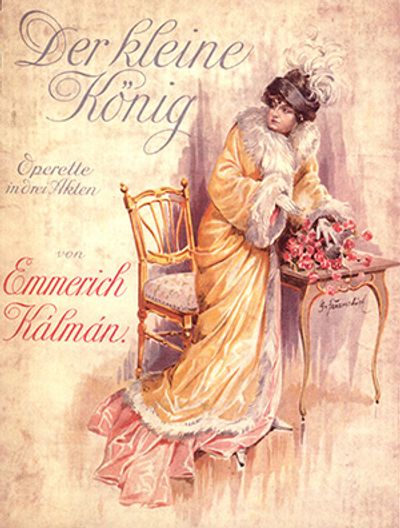
Der kleine König
Libretto by Robert Bodanzky, Karl von Bakonyi, and Ferenc Martos
Premiere: Theater an der Wien, Vienna, November 23, 1912
Act I: In the palace of the “Little King,” officers announce a visit by the ambassador of Paraguay. But it is Zaza, the cute ballerina decked out in her theater costume, who is actually admitted. His majesty is nowhere to be found, however. Zaza relates that the king, who has a keen eye for blondes, has vanished on the way to the changing of the guard. Aide-de-camp Lancelot has yet another story to tell. Accosted on the promenade by a badly dressed beggar, the king, having no money on him, gave the petitioner the Grand Cross of the Order of the Holy Baboon. Further word has is that the fun-loving, love-loving monarch is at the opera house, where the famous visiting diva Anita Montorini is performing as Carmen. The police chief enters excitedly and announces that a subversive woman—the daughter of the martyr of the February Revolution—is within the city walls under a false name. He is reassured by a reference to the old marshal, who has known the monarch since birth and has always provided the safest protection for king and country. Finally, the little majesty himself appears. He has had quite an adventure at the opera—the beautiful diva has utterly enchanted him. He has invited the lady for dinner and is now feverishly awaiting her response. Officers announce the arrival of the man with the Order of the Holy Baboon, a picturesque ragged fellow by the name of Huck, who desires audience with the king. Zaza appears for her weekly private audience with the monarch, whose mind, however, is now on Anita. Huck volunteers to take Zaza off his hands. Zaza takes a liking to the half-depraved man; when she hears that the king is awaiting a reply from an opera singer, she realizes that she herself is history with the king. As Zaza leaves in tears, the deeply dismayed marshal reports that Admiral Montbison, along with a deputation of malcontents, wants to ask for mercy for the convicts, but the king turns them down. Grudgingly, they yield to his will, while the “Song of Liberty” of the desperate crowd fills the alleys outside. Anita, who has refused the king’s dinner invitation, is forcibly brought to the castle, where she enthusiastically joins in the revolutionaries’ song. In front of the malcontents, she confesses to be the daughter of the hero who died as a martyr for freedom. She intends to seize the opportunity to be alone with the king to kill him. She requests that the clueless old marshal bring her from her carriage a bouquet of roses, in which she has hidden a bomb. But as soon as Anita faces the young, artless, elegant, and chivalrous king, her resolve softens. She is entranced by his childish exuberance; slowly, her hatred gives way to a nobler, more intimate feeling. And when the king sets aside his majesty to worship his beloved “shopkeeper” like a poor student, she quickly renders harmless the burning fuse of the bomb. Although the noise of the agitated crowd disrupts their meeting, the two young folks have found each other in sincere friendship. As a parting gift, Anita gives her royal friend a token of love—a flame-red rose.
Act II: In the music salon of the castle, Huck tells his bride Zaza about a diplomatic mission: he is to bring Anita and the king permanently together. Anita arrives and is warmly greeted by the king, who voices only one regret: that governing and love do not go together. Huck reports that the soldiers have to confront the crowd outside, which wants to celebrate the anniversary of the revolution. Anita realizes the danger that the king is in and wants to help him flee. But he doesn’t want to leave the country in such a state, even when his faithful marshal reports the defection of the last regiments. The monarch is informed who Anita actually was and that, as a paid agent of the revolution, she probably just wanted to persuade the king to flee. Because of her pride, she refuses an explanation to her lover. Anita implores the marshal to at least save the king’s life by signing the letter of abdication. There are no higher values than life, which awaits the king with all its pleasures. Heretofore he belonged completely to a whole country; from now on he is to belong only to her love, Anita assures herself. And the marshal indeed has the palace gates thrown open to the revolutionaries and orders the royalist troops to surrender. The insurgents occupy the palace. Outside, the country is proclaimed a republic, and the king, unafraid of death and seeing himself as abandoned and alone, has to abdicate. He is assured safe conduct and permitted to take along his “beloved.” And thus, with Darling, his favorite dog, and without looking at any of the humans who used to surround him, the Little King leaves throne and castle.
Act III: In the garden of a villa on the French coast overlooking the azure sea, the exiled “Little King” lives with his faithful followers. Huck is occupied with nothing but plans for a reconquest, and Zaza, his bride, is trying to straighten him out. Touching surprises await the ex-king at his birthday party. Ten former yeomen of the guard and the old marshal have come to renew their pledge of love and loyalty to their young former king. The retired king and the retired marshal (who wants nothing but to go on serving his little lord) embrace. However, Anita too has arrived, and soon all pending misunderstandings are cleared up. The exiled king and the famous singer want to build a new kingdom for themselves, a kingdom of love, from where no one shall expel them.